Formula One Data Systems Power Real-Time Health Tracking in MOBA Esports Events
Jonas Reed · Jun 10, 2026
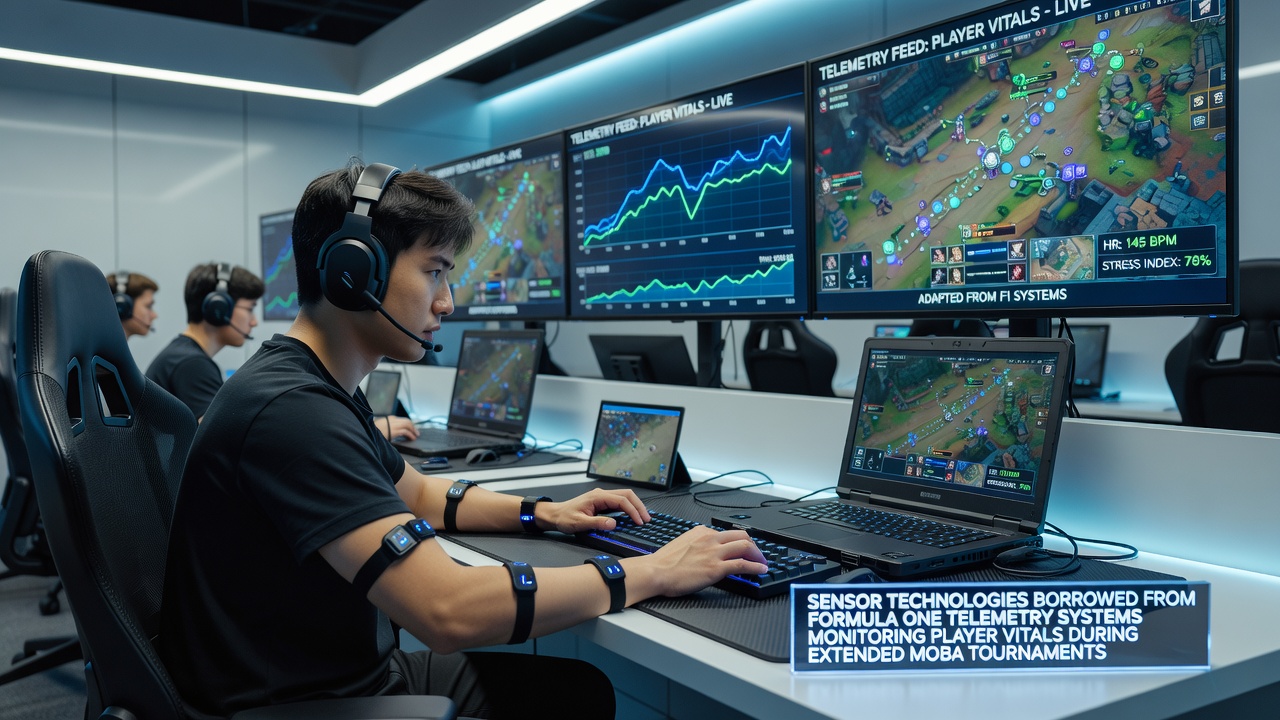
Formula One Data Systems Power Real-Time Health Tracking in MOBA Esports Events
Origins in Motorsports Telemetry
Formula One teams have refined telemetry since the 1980s when electronic data logging first appeared in race cars, and those same sensor architectures now support continuous vital sign collection for MOBA athletes during tournaments that stretch across multiple days. Accelerometers, gyroscopes, and heart rate monitors originally calibrated for chassis vibration and driver pulse now attach to esports competitors through lightweight chest straps and wrist modules that stream information at rates exceeding 100 hertz.
Engineers who once optimized tire temperature curves and brake wear models have adapted the same bandwidth management protocols to handle biometric streams without interfering with in-game network traffic, while medical staff receive alerts when core temperature or hydration markers move outside established thresholds.
Integration into Tournament Infrastructure
Event organizers began pilot programs in 2024 that placed F1-derived sensor packs on players during best-of-five series, and by June 2026 several major MOBA circuits had adopted standardized telemetry kits supplied through partnerships with automotive electronics firms. Data flows from the player to an on-site server rack where algorithms compare live readings against baseline profiles collected during practice weeks, allowing coaches to request short breaks when respiration rates climb above safe limits for sustained cognitive tasks.
Wireless protocols borrowed from pit-lane communications ensure that sensor packets reach medical stations within 200 milliseconds, a latency window first proven reliable during high-speed straights at circuits such as Silverstone and Monza. Tournament rules updated for the 2026 season now require at least one certified medical observer per team to monitor the dashboard that displays aggregated vitals alongside game state information.
Technical Specifications and Data Handling
Each sensor unit contains a triaxial accelerometer accurate to 0.01 g, a photoplethysmography module sampling at 250 hertz for heart rate variability, and a skin conductance electrode set originally designed to detect driver stress under cornering loads. Power consumption stays below 80 milliwatts because the same low-energy Bluetooth stack used in car-to-pit telemetry keeps the devices running through eight-hour match blocks without recharging.
Raw data packets travel encrypted to a central processing unit that applies filtering routines identical to those that clean suspension travel signals in Formula One, removing movement artifacts caused by keyboard and mouse activity. Aggregated metrics appear on coaching tablets as trend lines rather than raw numbers, preserving player privacy while still flagging deviations that might indicate fatigue accumulation over a best-of-seven final.
Case Examples from Recent Circuits
One European MOBA league implemented the system during its spring split and recorded a 12 percent reduction in player-reported dizziness episodes after staff began scheduling micro-pauses based on rising lactate estimates derived from heart rate recovery curves. In North America a similar deployment during a June 2026 invitational allowed medical teams to correlate a spike in skin conductance with an unexpected network latency event, confirming that external stressors rather than in-game pressure had triggered the response.
Research groups at institutions including the University of Sydney have published preliminary findings on how these adapted telemetry streams correlate with reaction time metrics collected through embedded game clients, yet those studies emphasize the need for larger sample sizes across multiple regions before generalized performance models can emerge.
Regulatory and Safety Framework
International esports federations coordinate with automotive standards bodies to ensure sensor calibration meets ISO guidelines originally written for motorsport data acquisition, while regional health authorities review data retention policies that limit storage of individual biometric records to 90 days after each event. Compliance documentation submitted for the 2026 season references telemetry validation reports issued by the Fédération Internationale de l'Automobile and cross-checked against wearable device directives from the European Union.
Insurance providers covering tournament organizers now require documented sensor uptime statistics exceeding 99.5 percent, a threshold first established in Formula One reliability audits and later adopted because extended MOBA sessions expose competitors to cumulative physical loads comparable to those measured in endurance motorsport stints.
Future Development Pathways
Hardware iterations scheduled for late 2026 include additional near-infrared spectroscopy channels that could estimate cerebral oxygenation levels, building directly on prototypes tested in open-wheel cockpits where drivers face similar sustained attention demands. Software teams continue to refine machine learning classifiers trained on anonymized datasets from both racing and esports environments, aiming to predict when a competitor's decision latency may increase beyond baseline before any visible performance drop occurs in match logs.
Manufacturers report that component costs have fallen by roughly 35 percent since initial esports deployments because production volumes now include both motorsport and gaming markets, allowing economies of scale that were unavailable when sensors remained exclusive to race teams.
Conclusion
Telemetry architectures refined over decades in Formula One now supply the measurement backbone for vital sign oversight during prolonged MOBA competitions, delivering standardized data streams that support both immediate safety interventions and longer-term research into competitor endurance. Continued collaboration between automotive electronics specialists, tournament organizers, and academic researchers continues to shape how these systems evolve for the 2027 circuit calendar and beyond.